
What is a public tender?
A public tender is a formal competition run by a public buyer — a ministry, municipality, hospital, agency, or another body covered by procurement law. The buyer describes the work, sets a deadline, and says how offers will be judged. Suppliers who want the contract submit an offer under those rules, or they decide not to.
People use “tender” for the announcement, the documents, and the offer itself. On this page, a tender opportunity means the competition you might pursue. The tender pack is the specification, contract, forms, and amendments you have to answer. Procurement is the wider buying process. A tender is the competitive part of it.
A shorter definition, written for a first reading, sits in what is a tender? This page is the hub: what public tenders are, where tender opportunities are published, and which guides to read before a team spends days on a bid.
What is the difference between a notice and a tender?
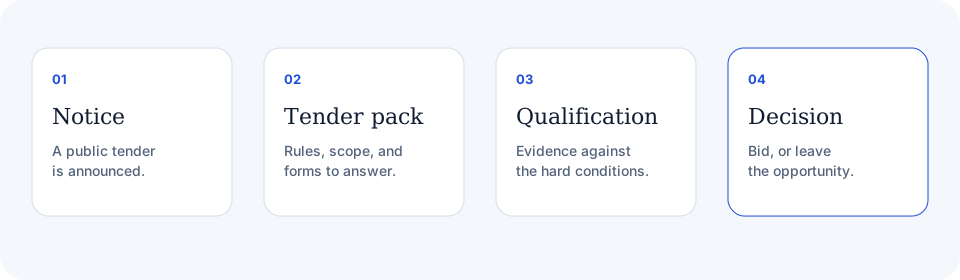
A notice tells you that a buyer intends to award a contract. It usually names the buyer, the subject, a place, and where to go next. It is the tender opportunity as the outside world first sees it. It is rarely the full set of rules.
The tender pack holds the instructions, the scope, the selection and award criteria, the pricing schedule, and the forms. Later amendments and published answers become part of that pack. Teams that write from the notice alone are answering a summary. Open the official notice, then obtain the documents, before anyone treats the result as a bid.
Where are tender opportunities published?
Use the official journal for the market you can actually serve, then the buyer’s own portal for the documents. Aggregators can be convenient. They are not the legal record, and they can miss an amendment.
- TED publishes many European public procurement notices. The notice points to the tender documents; it does not replace them.
- Find a Tender publishes higher-value UK notices. Below-threshold work often stays on the buyer’s own site.
- SAM.gov is the official system for US federal opportunities.
TenderFaro discovery searches TED and UK Find a Tender. SAM.gov search is available when a server credential is configured, and the product says so rather than inventing results. Importing a notice stores it for your organisation and does not start an analysis. The practical routine is in how to find public tenders worth opening.
How does a public procurement run?
Most public tenders follow the same practical sequence, even when the legal name of the procedure changes by country. A notice is published. Suppliers collect the pack and watch for amendments. Questions, where they are allowed, are answered for every bidder. Offers are submitted by the stated deadline, in the stated place, in the stated format. The buyer checks exclusion and selection conditions, scores the offers that remain, and notifies the award. Some laws then require a standstill period before the contract is signed.
Frameworks, lots, and two-stage competitions change the timing. Read the procedure named in the pack. The journal article on how public tenders work walks through that sequence, and the glossary of tender and procurement terms defines the labels buyers use for each step.
Which tenders are worth pursuing?
A tender opportunity is worth opening when the subject is work you have delivered, the place is somewhere you can contract, and the dates are still possible. It is worth a bid only when the mandatory conditions match evidence you can submit, and the team has time to answer the questions the buyer will actually score.
Late files, missing forms, and expired certificates are the usual reasons a bid is set aside. Those failures are visible in the instructions before writing starts. Common mistakes that disqualify tender bids lists them. How to write a winning tender response covers what to do once the bid is real: answer the published questions, with proof an evaluator can find. Nothing on this site guarantees an award.
How TenderFaro fits this work
TenderFaro does not award contracts and does not decide legal eligibility. It helps a team search published notices, turn a tender or RFP into structured requirements, and compare those requirements with company evidence, with the source wording kept next to the finding. Gaps and potential blockers stay visible for a person to review.
The product boundary matters. A search result is not a tender pack. A watch match is not a recommendation to bid. An evidence comparison is not a compliance ruling. The company makes the decision. You can see the product path in discover tenders, how TenderFaro works, and a sample analysis.
Public tenders by country
These guides explain how a public tender works in one market: where the notice is published, which rules set the procedure, and what a foreign bidder should read before writing.
What should you read next?
Frequently asked questions
What is a public tender?
A public tender is a formal competition in which a public buyer asks suppliers to submit offers for goods, services, or works. The notice announces it. The tender documents set the rules.
Where are tender opportunities published?
Start with the official journal for the market you can serve. Many European notices appear on TED, UK higher-value notices on Find a Tender, and US federal opportunities on SAM.gov. The buyer's own portal usually holds the full tender pack.
What is the difference between a tender and a procurement?
Procurement is the whole buying process, from the need through to the contract. A tender is the competitive part of that process, when suppliers are invited to bid. Not every procurement is a public tender.
Does finding a tender opportunity mean you should bid?
No. A notice means a competition exists. Read the tender pack, compare the mandatory conditions with evidence you can submit, and decide whether the team has the capacity to respond properly.
Does TenderFaro award public tenders?
No. TenderFaro helps teams find published notices, structure requirements, and compare them with company evidence. People review the sources and make the bid decision.